Note of caution: Mentions of natural disasters are included in this Insights piece
Last week was the statistical midpoint of Atlantic hurricane season, the storm season that runs roughly June through November across the eastern half of North America, Central America, and the Caribbean. I’m anchoring this piece to that season because it’s the one I lived through, but disaster season looks different depending on where you are: the Western Pacific faces typhoon risk nearly year-round, and the Southern Hemisphere’s cyclone season runs the opposite half of the calendar, from roughly November to April. If you have never worked for a nonprofit through a named storm, it is worth picturing what that midpoint actually feels like from inside one: the quiet before impact, when the forecast cone tightens, and a leadership team starts doing math nobody trained them for. How many program participants. How many beds. How many staff. How many days of food, formula, and medication on hand. And how much of it will still be standing on the other side.
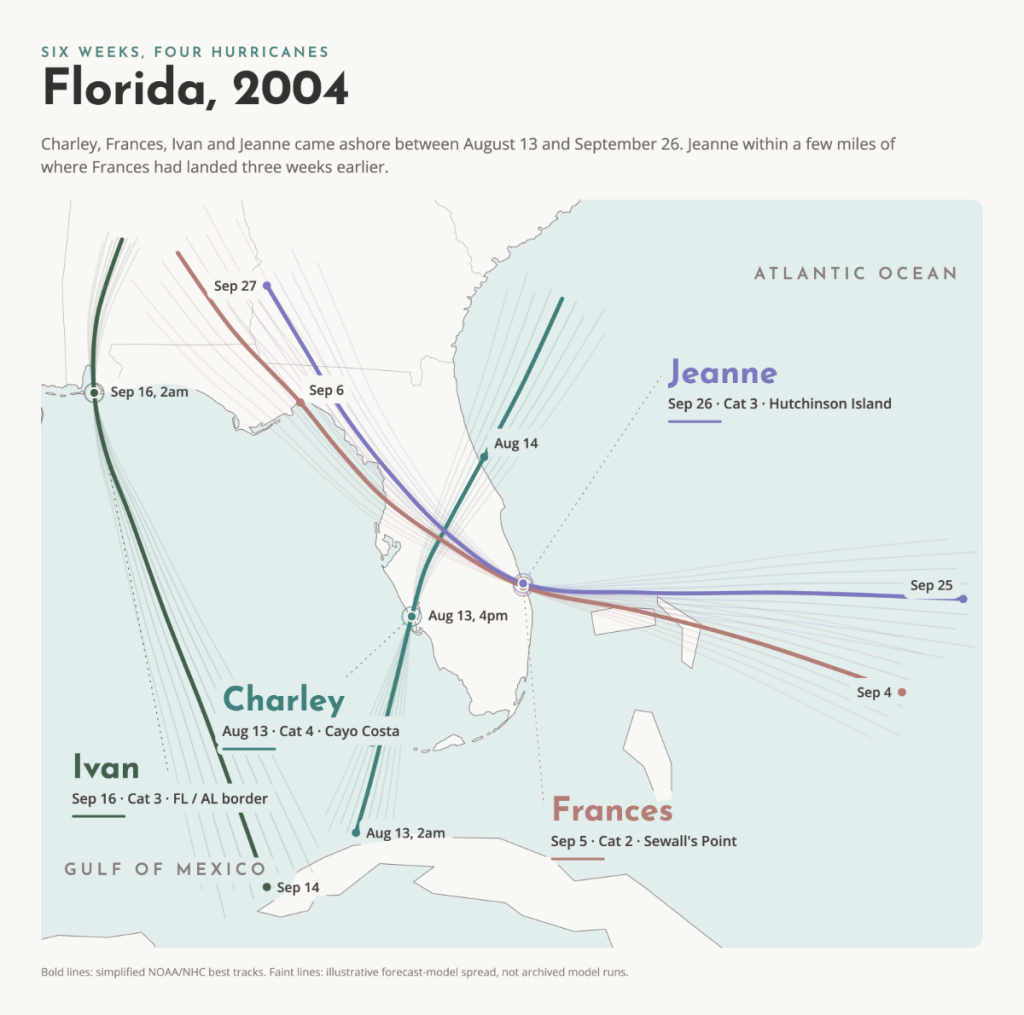
In 2004, Florida did not get one hurricane. It got four: Charley, Frances, Ivan, and Jeanne, making landfall within six weeks of each other, the only time in recorded history that four hurricanes have struck a single U.S. state in one season. By the time the last one passed, there was almost no corner of the state that had gone untouched. Forty-two domestic violence centers across Florida, every certified center in the state, were affected that season, though not all in the same way. Some took direct hits: shelters that were supposed to be the safest place in a community for someone fleeing violence were themselves damaged past occupancy, some beyond repair. Others were affected differently. Centers that had been spared mobilized to support the ones that had not: sending advocates to impacted areas to cover shifts so local staff could step away long enough to handle insurance claims and the dozens of other post-disaster logistics that pile up after a storm, taking over crisis line coverage entirely so calls could roll over to advocates working from unaffected parts of the state, and opening available beds to survivors whose own shelters had to evacuate. Advocates who had spent years learning how to hold space for other people’s crises were now living through their own, in whatever form it took: roofs gone, cars totaled, kids displaced from school, and still, somehow, expected to show up the next morning for a hotline that does not stop ringing because the building it runs out of has a blue tarp where the roof used to be.
Natural disasters have a way of bringing out both the worst and the best in people. I choose to focus on the best. Providing grace during a crisis matters to me, and 2004 gave me plenty of it to hold onto: advocates who picked up extra shifts without being asked twice, centers that made room for survivors from other shelters on top of the survivors they were already serving, a whole state’s network of helpers choosing, again and again, to show up for each other.
I moved to Tallahassee from New York State in 2001. I was brand new to Florida and had never lived through a hurricane. Before the move, I had worked as an advocate at a large urban domestic violence program. In Tallahassee, I took another direct-service advocacy role at the local program, which served eight counties, many of them rural, well beyond Leon County itself, working directly with survivors and their children. That continued until January 2004, when I moved into statewide work with the state’s membership organization for Florida’s 42 certified domestic violence centers. None of that direct-service experience had prepared me for how completely a hurricane disrupts every part of a person’s life: the anxiety of watching a cone of uncertainty shift for days before a possible landfall, the scramble to build an evacuation plan while still trying to function as a professional whose job is to help others do the same. I was not in the direct path of any of the four storms myself. I was working in support of the statewide response. Even from that distance, I was not equipped for what it taught me, and it changed how I think about disaster response for the rest of my career.
I tell this story as a hurricane story because that is where I first learned it. But nothing in what it taught me is specific to wind and storm surge. Whether your organization’s version of 2004 arrives as a wildfire, a flood, a tornado outbreak, an active shooter event, a cyberattack, or a public health emergency, the underlying discipline is the same. Climate change has made that discipline harder to opt out of. Disasters are not only more frequent now; they are more intense, they overlap in ways they did not used to, and they increasingly touch organizations and regions that never used to plan for them. Preparedness can no longer be filed under “if this applies to you.”
THE INSIGHT I COULD NOT UNLEARN
Here is what six weeks of consecutive hurricanes taught me: you can build a disaster response system under pressure. People do it constantly, and often heroically. Programs figure out mutual aid agreements with the next county over while the first storm is still spinning offshore. Staff already scheduled for the overnight shift end up riding out the storm on-site because the roads are too dangerous, or too flooded, for a relief shift to reach them. Somebody’s cousin with a generator becomes, overnight, the reason an entire shelter has hot water.
But you should not have to build it under pressure. Every improvised solution in the middle of a crisis is a decision that could have been worked out, tested, and agreed upon months before the crisis arrived. What made the biggest difference in 2004 was not which organizations had the most heroic staff. Every organization I worked alongside had heroic staff. What made the difference was which ones had already answered the hard questions while the stakes were still low: Where do program participants go if this building is unusable? Who has authority to make decisions if the director cannot be reached? What is our plan for staff who are managing their own losses while trying to run our programs?
Real preparedness is not a binder. It is a set of relationships, decisions, and resources that exist before you need them, so that a crisis becomes a matter of execution rather than invention. That distinction, between building under pressure and building before it, is the whole of what I want nonprofit and social impact leaders to sit with this hurricane season.
THE LESSONS THAT TRAVELED
I didn’t know it at the time, but 2004 was a rehearsal for a career spent showing up in the middle of other people’s worst weeks. Katrina followed a year later, and everything Florida had taught me about coordinating across a devastated region, when standard supply chains, standard communication, and standard operations of every kind had failed, applied at a scale I had not imagined possible. Superstorm Sandy taught me how disaster response looks different in dense urban environments, where the challenge is not distance but density: shelters serving neighborhoods that had never needed emergency services before, in buildings never designed for it. Deepwater Horizon taught me that disaster is not only weather. A slow-moving industrial catastrophe creates its own version of displaced staff, disrupted funding, and communities in crisis, and the underlying discipline of preparedness holds regardless of what prompts the emergency.
That accumulated experience helped lay the foundation for “Domestic Violence Advocacy: A Disaster Response,” a curriculum I helped develop with the National Domestic Violence Hotline. It came from lessons learned in 2004 that proved true in every disaster that followed, and from the belief that no advocate should have to learn them for the first time in the middle of an evacuation.
Even that accumulation of experience never added up to being fully equipped. I don’t think it does for anyone. Every disaster is different enough that it teaches you something you did not know you needed to ask about, no matter how many you have already been through.
One of those lessons surfaced when I was asked to work with federal disaster response teams on the specific needs of domestic violence and sexual assault programs during large-scale disasters. Advocates in this field are trained to assess safety through an ongoing, trauma-informed conversation, not a single yes-or-no question. Red Cross shelter intake works differently, and for good reason: staff are trained to observe and screen for immediate medical, functional, and physical needs, not to ask a standardized safety question outright. Anyone showing visible distress or acute needs is referred to specialized Disaster Health Services or Disaster Mental Health personnel, who provide psychological first aid and emotional support. That system works well for what it is built to catch. But a survivor of domestic violence’s danger does not always look like visible distress. They may be doing everything they can to appear calm and unremarkable, precisely because they do not want to be noticed, especially if the person they are afraid of might also be looking for them. An observation-based intake process, built to flag people who are visibly struggling, can miss exactly the survivor who has the most at stake in not appearing to struggle at all.
That distinction became part of what I built into the training for federal responders, and it is exactly the kind of critical thinking that is nearly impossible to anticipate until you have lived through the gap it creates. It is also why I started urging domestic violence programs to build relationships with their local Red Cross chapters long before a storm ever forms, not after. A survivor may end up in a Red Cross shelter because their own emergency shelter had to evacuate, or because they were never in a domestic violence shelter to begin with but have real safety concerns of their own – an abusive partner or former partner who might come looking for them at exactly the kind of general-population shelter a disaster tends to fill. Relationships built months or years in advance are what let a Red Cross shelter recognize that nuance and respond to it, instead of relying on an intake process built to catch visible distress, one that a survivor with the most at stake in hiding theirs can slip straight through.
WHY THIS IS NO LONGER A NICHE COMPETENCY
For most of my career, disaster preparedness was treated as a specialty: something organizations in hurricane alleys or earthquake zones needed, and everyone else could reasonably deprioritize. The pandemic ended that. Almost overnight, organizations that had never opened an emergency plan, because they never thought they needed one, were making life-and-death decisions about continuity of services, staff safety, and operations under conditions nobody had modeled for them. Many nonprofit and social impact leaders learned in 2020 what I learned in 2004: you don’t get to choose when your organization needs a plan, only whether one exists when it does.
That shift matters because it changed what “worst case” means when you sit down to plan. It is no longer enough to picture the manageable version of a crisis: a few days of disrupted services, a temporary relocation, a rough quarter. Planning must contemplate the scenarios leaders instinctively want to look away from, including the loss of staff or program participants, the loss of a facility for good, or a crisis that outlasts your funding runway. I understand the impulse to keep planning conversations at the comfortable end of the spectrum. But an organization that has only rehearsed the mild version of a disaster will be improvising exactly when it can least afford to.
The math backs up what those of us in the field have felt for years. NOAA’s own data show the average gap between billion-dollar weather disasters in the U.S. has shrunk from 82 days back in the 1980s to roughly 16 days over the past decade; in 2025 alone, the country absorbed one about every 10 days. And the readiness gap isn’t unique to hurricane-prone regions or nonprofits. A 2025 U.S. Chamber of Commerce Foundation study found that while the vast majority of small and mid-sized organizations believe they are ready for a disaster, fewer than one in three actually have a plan in place. That gap, between how ready we feel and how ready we are, is exactly what nearly cost my colleagues everything in 2004, and it has only gotten more expensive to ignore since.
None of this is a U.S.-only story, and I want to name that directly, since I now work with nonprofit and social impact leaders around the world, not just in the U.S. EM-DAT, the international disaster database maintained by the Centre for Research on the Epidemiology of Disasters, recorded 393 disasters worldwide in 2024 alone, affecting more than 167 million people and causing an estimated $242 billion in damage. Global disaster frequency has climbed from roughly 100 events a year in the 1970s to around 400 a year over the last two decades, and climate-related disasters specifically are up more than 80 percent over the last four decades. Wherever your organization operates, the trend line points in the same direction.
I also want to name a category of expertise this piece has not yet acknowledged: the people who do this work full time, year-round, across the globe, moving from one disaster to the next as a vocation rather than an occasional emergency. I learned what six weeks of hurricanes could teach someone new to the field. They have spent entire careers learning what disaster after disaster, on every continent, can teach someone who never fully stops responding. Their accumulated lessons are, in many ways, deeper than mine, and nonprofit and social impact leaders would do well to seek out that expertise directly, not only through people like me who encountered disaster response earlier in a career built on something else.
HELP THE HELPER
If there is one principle from the hurricane season of 2004 that taught me what I want every nonprofit leader to carry into this season, it is this: help the helper. A disaster plan that accounts for program participants but not for staff is not a disaster plan. It is a liability.
The phrase isn’t originally mine. I learned it, and so much else about caring for the people who care for others, from Dr. Charles Figley and Dr. Kathy Regan Figley. Charles, who refers to compassion fatigue as “the cost of caring,” has spent decades as one of the field’s leading scholars defining and researching the secondary trauma experienced by responders, clinicians, and caregivers, research that took him from the 1989 Loma Prieta earthquake to post-Katrina New Orleans, where he went on to hold Tulane University’s Kurzweg Chair in Disaster Mental Health. Kathy has spent just as many decades as a field practitioner in trauma and compassion stress management, working directly with first responders, clergy, clinicians, and emergency managers under her own specialty of field traumatology. Both mentored me during a period of my career when I was based in Florida. Kathy and I also responded to disasters together in the field more than once. Whatever I know about helping the helper, I know because they taught it to me first, and because Kathy brought me into the field to practice it alongside her.
In 2004, I watched advocates keep working while their own homes were unlivable. Some of them were extraordinary in that moment, and I am proud of what we accomplished together. But I no longer believe that kind of endurance should be the plan. An organization that assumes its staff will simply absorb whatever the disaster costs them, on top of everything they already carry, is building its resilience on people’s willingness to sacrifice, not on infrastructure. That is not sustainable, and in a field built on trauma-informed practice, it is not consistent with what we claim to believe about the people who do this work.
Helping the helper means staff have their own evacuation and communication plans, not just program participants. It means paid time genuinely protected for staff to attend to their own losses, without guilt or an unspoken expectation that they will cut it short. It means leadership checks in on wellbeing during and after a disaster with the same rigor it applies to service delivery metrics. Organizations that build this in advance recover faster, because they are not simultaneously trying to hold their people together and hold their programs together with the same depleted hands. This is also, simply, what it means to be a trauma-informed organization: one that extends the same care to the people delivering services that it asks them to extend to everyone else.
A PRE-SEASON READINESS CHECKLIST
Whatever disaster is most likely to reach your organization, and increasingly, more than one kind is, the middle of an active threat is not the moment to start this work. Hurricane season is simply a useful, recurring prompt to check it. Here is where I would start:
- Confirm your continuity of operations plan is current, not the one from three directors ago, and that current staff have read it.
- Identify backup facilities and mutual aid partners now, in writing, before you need a place to send program participants or staff on short notice.
- Build a staff communication plan that does not depend on a single system. If your primary communication channel requires power or cell service, have a second one that does not.
- Establish clear, documented decision-making authority for who can make emergency calls if your executive director or board chair is unreachable.
- Protect dedicated time and support for staff well-being, before, during, and after an event, and say so explicitly in your plan rather than assuming it will happen informally.
- Review your funding and cash reserves for a disruption scenario, including how you would meet payroll if revenue or reimbursements are delayed for weeks.
- Debrief on a fixed schedule, disaster or no disaster. The organizations that improve the most are the ones that treat even a quiet year as a chance to test the plan.
None of these items are complicated. What they require is the discipline to do them in June, not October.
WHERE THIS WORK LIVES
I still think about that season more than twenty years later, not because it was the hardest thing I have navigated, though it was close, but because of what it taught me about the gap between improvisation and preparedness. Closing that gap, before the next storm, the next flood, the next crisis nobody saw coming, is the work I do now with nonprofit and social impact leaders through Crisis & Disaster Support.
If your organization hasn’t stress-tested its plan this year, hurricane season is a good prompt, but it doesn’t have to be the reason. The next disaster likely won’t announce itself in advance, and it may not arrive in the form you expect.